
Last updated November 15, 2026
 Wrought iron
 Wood & steel frame
 Farm & ranch
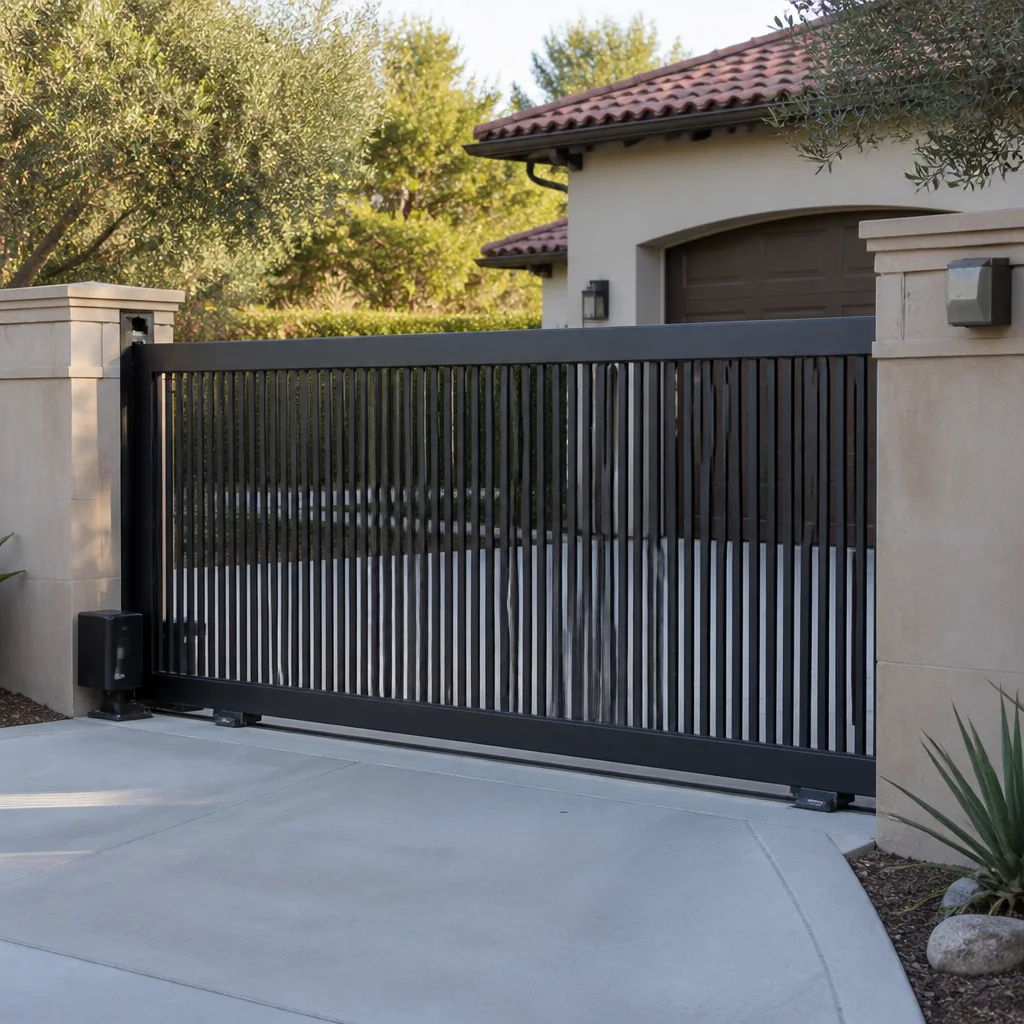 Sliding driveway gates
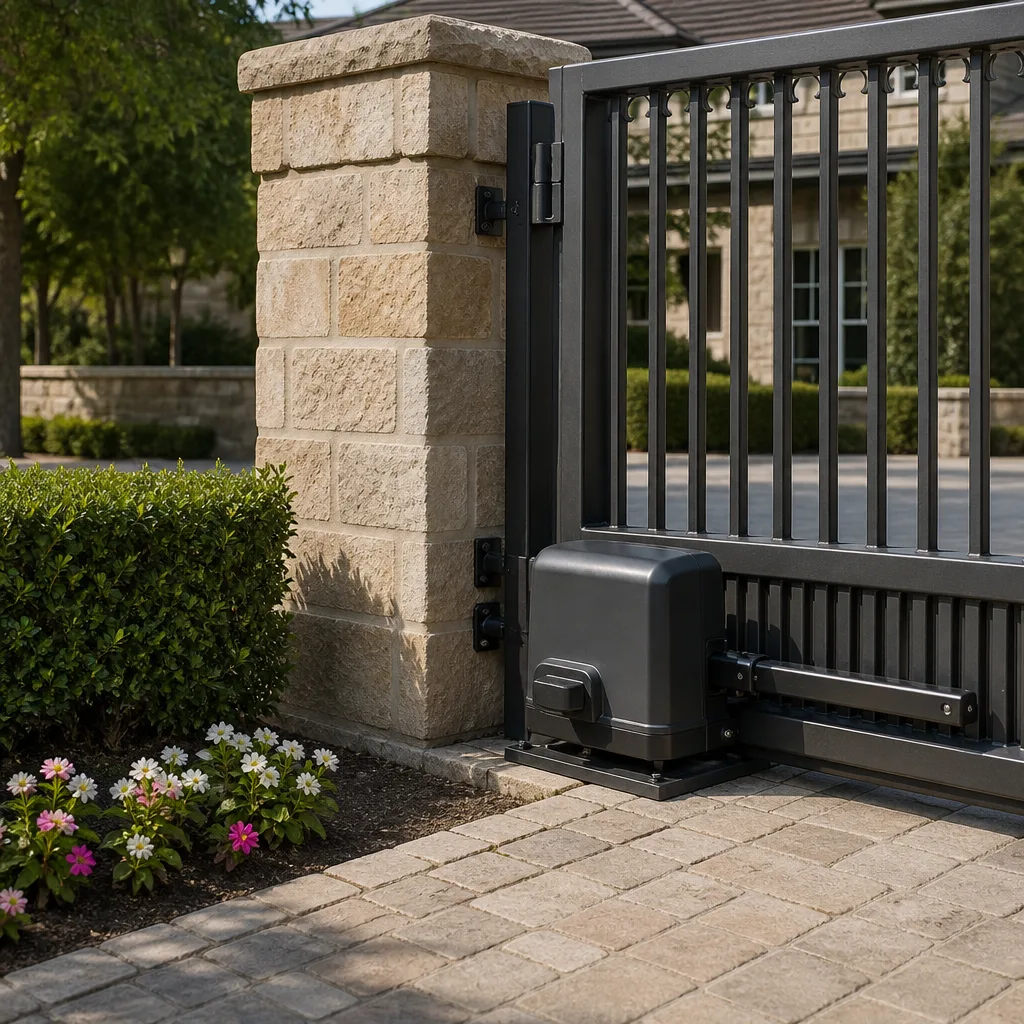 LiftMaster operators
Free on-site gate assessment - hinges, posts, and your LiftMaster or Nice gate operator checked before anything is quoted
The assessment is free and the quote is the invoice.
Get your free estimateGate Repair Maintenance Schedule: What to Do and When
Most manufacturer maintenance charts are written for a generic climate. They suggest lubricating hinges twice a year and calling it done. That advice falls apart in Pompano Beach. The forces that wear out gates here are storm-driven rain, months of heavy humidity during the June-through-October wet season, and warm temperatures that quietly cook backup batteries and grime up moving parts. A schedule copied from a national owner’s manual will leave you reacting to failures instead of preventing them. What follows is a working calendar built for how gates actually age in Pompano Beach, what to check before and after storm season, which lubrication points get skipped, and what to log so any technician can diagnose faster. We’ll also show you where the motor, the control board, and the hardware each need their own attention cadence.
Quick Answer
Maintain a gate in Pompano Beach on a quarterly core cycle with extra checks timed to the storm season: inspect and lubricate hinges, rollers, chains, and racks every three months, test the battery backup and safety edges the same day, run a full hardware and structural inspection each spring before hurricane season peaks, and do a post-storm walkthrough after any named system passes through. Electric operators, whether a residential swing opener or a commercial slide system, need their control board, limits, and photo-eye alignment checked at each quarterly visit, not once a year.
Styles & brands we work with
- Wrought iron
- Wood & steel frame
- Farm & ranch
- Sliding driveway gates
- LiftMaster operators
Table of Contents
- Why Generic Gate Schedules Fail in Pompano Beach
- The Month-by-Month Gate Maintenance Calendar
- Material-Specific Intervals: Aluminum, Wrought Iron, and Vinyl
- The Three Lubrication Points Most Technicians Skip
- Battery Backup: Why Quarterly Testing Beats Annual Testing
- Pre-Hurricane-Season Inspection Checklist
- Post-Storm Walkthrough: What to Check and When to Stop
- What Your DIY Maintenance Log Should Capture
Why Generic Gate Schedules Fail in Pompano Beach
A maintenance plan only works if it matches local conditions. Pompano Beach sits in a wet subtropical climate where heat and humidity do most of the damage across the whole year, not just in summer. Metal parts stay damp long enough for surface oxidation to take hold, especially on bare or freshly scratched aluminum and steel. During the wet season, frequent afternoon storms push water into operators, hinges, and control housings that a drier climate would leave alone. Cold-weather gate charts spend their energy thinking about ice and salt; neither applies here. What matters in Pompano Beach is moisture management, warm-temperature battery stress, and debris lodged by blowing rain.
There’s a second reason national schedules fail: they ignore automation. A gate driven by a FAAC or BFT operator has moving electronics, limit switches, photo eyes, and a control board on top of the physical hardware. A schedule that only covers hinges and a squirt of oil leaves the parts that actually strand people unmonitored. We work on the brand you already have across nine major gate brands, so we’ve watched plenty of gates where the mechanicals were fine and the operator was one skipped battery test from failing shut. The right schedule treats the gate and the system driving it as one machine.
The calendar below assumes nothing fancy: a gate on a residential driveway or a commercial entrance in Pompano Beach, a power supply, and a person willing to spend fifteen minutes a quarter doing a visual pass. If you’d rather have the whole thing done by an electric gate repair specialist who knows the operator, that’s what we’re here for.
The Month-by-Month Gate Maintenance Calendar
Rather than one big annual service, break the year into quarterly blocks. Each block covers the core mechanicals plus a seasonal focus tuned to Pompano Beach weather. Heres the rhythm we recommend.
- January to March (dry-season reset). Do a full inspection after the wetter months: check for oxidation on bare metal, clean and lubricate hinges and rollers, tighten bolt and hinge fasteners, and look at the gate’s clearance and level. This is the quarter to replace dried-out seals and clean the operator housing before storm season.
- April to June (pre-season prep). Run the pre-hurricane-season checklist in full. Load-test the backup battery, test safety edges and photo eyes, confirm manual release works, and check that the gate can be opened by hand if the power drops. Tighten anything that wiggled over the dry season.
- July to September (peak storm watch). The core quarterly tasks still apply, but add a debris sweep after any storm and watch the operator for sluggish movement from heat and humidity. Re-test the battery if the gate sat idle during an outage.
- October to December (post-season repair window). Do the post-storm walkthrough and repair anything the season loosened. Replace worn chains, racks, or rollers now, before a slower gate turns into a stuck one. Clean and inspect again ahead of the next dry season.
In our experience the gate owners who never have a surprise failure are the ones doing the small quarterly pass. It takes less time than organizing a big annual repair, and it catches wear while it’s still a five-minute fix.
Material-Specific Intervals: Aluminum, Wrought Iron, and Vinyl
Not every gate ages the same way, even on the same street in Pompano Beach. Match your inspection frequency to the material.
- Aluminum gates. Aluminum resists rust well, but humidity and warm temperatures can dull the finish and let white oxidation form on uncoated or scratched surfaces. Inspect painted or powder-coated aluminum every quarter; touch up chips promptly so the bare metal doesn’t start to pit. Aluminum is light, so hinges and fasteners loosen faster than on heavier gates – re-tighten at each quarterly pass.
- Wrought iron and steel gates. These are the most vulnerable. Any scratch, weld, or worn paint point is where moisture gets in and rust starts. Inspect every quarter, look closely at welds and low corners where water pools, and treat any rust spot as soon as you spot it. Heavy steel gates also stress their hinges and posts, so watch for sag at each visit.
- Vinyl gates. Vinyl shrugs off moisture, but it can crack in prolonged heat and it hides structural problems better than metal. Inspect every six months for cracks, loose fasteners, and any gap at the post. Vinyl won’t rust, but the metal frame and hardware holding it still will, so check those parts on the metal schedule.
You’ll notice aluminum and steel get the quarterly treatment while vinyl can stretch to twice a year. That’s the practical split for this climate. On any automated gate, the operator schedule overrides the material schedule – the motor and control board still need their quarterly check no matter what the gate is made of.
The Three Lubrication Points Most Technicians Skip
Lubrication is where a lot of maintenance quietly goes wrong. People oil the obvious hinge barrel and stop there, then wonder why the chain or rack is wearing out early. Three points cause most of the premature wear, and all three are easy to miss.
- The chain or rack on the operator side. On slide gates, the exposed rack and pinion – or the drive chain – is where grit and moisture collect. A dry chain wears fast and snaps; a dry rack strips teeth. Clean it of debris, then apply a thin lubricant made for the job. This is one of the most overlooked wear sources on automated gates.
- The roller and idler bearings. On sliding gates, rollers and the guide idler carry the whole panel. If the bearings dry out, they seize gradually and you may not notice until the operator starts straining. Lubricate the rollers and check they spin freely – dry, dragging rollers are a common reason operators burn out.
- The operator’s own moving linkage and arm. On swing operators, the arm or linkage that pushes the gate needs lubrication at its pivot points. Skip it and the operator works harder every cycle, shortening its life and risking a stuck gate.
The pattern behind all three: the parts driven by the operator wear first because they carry the load, and they’re the easiest to forget. Lubricate them on the same quarterly cycle as your hinges. If a chain or rack is already worn beyond what lubrication will fix, that’s a hardware job – one more reason the gate and its operator deserve a technician who handles both, not a generalist guessing at it.
Battery Backup: Why Quarterly Testing Beats Annual Testing
Sealed lead-acid batteries are the weak spot in almost every automated gate, and warm climates make it worse. Heat speeds up how fast a lead-acid battery ages, so a battery in a Pompano Beach operator can lose capacity faster than the same battery in a cooler climate. A once-a-year test is too slow. By the time an annual check notices the battery is weak, it may already fail to hold the gate open through the next power cut.
Do a load test every quarter. That means running the gate on battery backup alone, with the power disconnected, and confirming it opens and closes cleanly for a full cycle or two. Watch for signs of weakness: a gate that moves slower on battery, a controller that beeps or shows a low-battery light, or a cycle that cuts out partway. Any of those means it’s time to replace the battery, not to hope it lasts one more storm. The operator brands we work with – LiftMaster, FAAC, BFT, Linear, Viking, Ghost Controls, DoorKing, Elite, and Mighty Mule – all rely on a healthy backup battery to keep access working when the power drops, and a weak battery turns a power outage into a locked-in or locked-out property.
This quarterly battery habit is one of the highest-value things you can do. Batteries are affordable relative to the downtime a failed backup causes, and a maintained battery is what lets the gate do its job when it matters most.
Pre-Hurricane-Season Inspection Checklist
Storm season runs June through October in Pompano Beach. Before it peaks, walk the gate with this list. It’s the single most important inspection of the year.
- Check post anchors, hinges, and bolts for looseness or movement. Wind load finds every loose fastener.
- Test the operator’s manual release. Confirm you can open the gate by hand if the power is out.
- Load-test the backup battery and confirm the gate cycles on battery alone.
- Test safety edges and photo eyes – the safety features need to work before the storm, not after.
- Clear debris and trim vegetation away from the gate’s travel path so nothing jams during high wind.
- Look at the material: touch up any rust or bare spots before the wet season accelerates them.
- Confirm the control board and housing are sealed and free of standing water or insect nests.
Do this before the first big system is on the radar, not the day it’s forecast. If anything on the list looks off – a soft hinge, a battery that won’t hold, a photo eye that’s out of line – that’s the moment to fix it. Our gate repair team runs these pre-season inspections routinely, and catching a problem now is always cheaper than an emergency repair after the storm.
Post-Storm Walkthrough: What to Check and When to Stop
After any named storm or heavy system, walk the gate before you run it. The order matters.
- Inspect visually first, with the power off. Look for a panel off its track, bent hardware, or debris wedged in the travel path.
- Check the posts and anchors for shifting. A gate that leans can bind hard the first time the operator tries to move it.
- Clear debris from the track or swing arc before restoring power.
- Look inside the operator housing for water intrusion, especially after driving rain.
- Restore power and run one slow cycle by hand-controlling the gate. Listen for grinding or straining.
- Test the safety edges and photo eyes again – alignment often shifts after a storm.
One safety note we take seriously: if a gate panel is hanging loose, if hardware is bent, or if the gate won’t close and latch and could swing free, stop and call a technician. Heavy gate panels can crush, and a slide gate off its track is dangerous to force back into place by hand. Don’t run a damaged operator, and don’t try to straighten bent hardware yourself on a loaded gate. This is where a dedicated gate professional earns their keep – we can assess whether it’s a hardware repair or a full Gate Repair Pompano Beach call.
What Your DIY Maintenance Log Should Capture
A simple log makes every future repair faster and cheaper, because a technician can diagnose from your notes instead of starting from zero. Keep it on paper or a note on your phone, and record the same fields each time.
- Date and what you did. Every inspection, lubrication, battery test, and repair, with the date.
- Battery load-test result. Whether the gate cycled on battery alone, and how it felt – full speed, sluggish, cut out.
- Observations, not just verdicts. “Hinge on street side feels loose,” “small rust spot on bottom rail,” “gate slows near the closed position.” Specific notes beat “looks fine.”
- Noises and behavior during cycles. Grinding, clicking, a pause mid-cycle, a beep from the controller.
- Brand and model of the operator if you know it, so the technician arrives with the right parts mindset.
- Anything you changed. A new battery, a tightened hinge, a setting you adjusted.
When you call, those notes let us pinpoint whether it’s the motor, the board, or the hardware instead of guessing. That accurate diagnosis first approach is how you avoid paying for parts you didn’t need. If you’re near the beach or a couple of miles inland across Pompano Beach, keep the log close at hand – a good history saves time on-site.
Common Mistakes to Avoid
- Following a national maintenance chart blindly. A schedule built for a cooler, drier climate misses the humidity and storm stress that drive gate wear in Pompano Beach. Tune your intervals to the local weather.
- Testing the backup battery only once a year. Warm temperatures age sealed lead-acid batteries faster; an annual test can miss a failing battery. Load-test quarterly.
- Oiling only the visible hinges. The chain or rack, the roller bearings, and the operator linkage are the parts that wear first and get skipped most. Cover all three points.
- Ignoring small rust and bare spots. A speck of rust on wrought iron in humid Pompano Beach spreads faster than you’d expect once the wet season starts. Treat it the same week you spot it.
- Running the gate after a storm without a visual check. A panel off its track or debris in the arc can bend hardware or damage the operator on the first cycle. Inspect before you energize.
- Assuming the operator is fine because the gate moves. A slowly weakening motor or battery can hide behind a gate that still opens – until the power drops. Test the backup, not just the normal cycle.
- Skipping the manual release test. In a storm or outage you may need to open the gate by hand. If the release is seized, you’ll find out at the worst moment.
See the difference
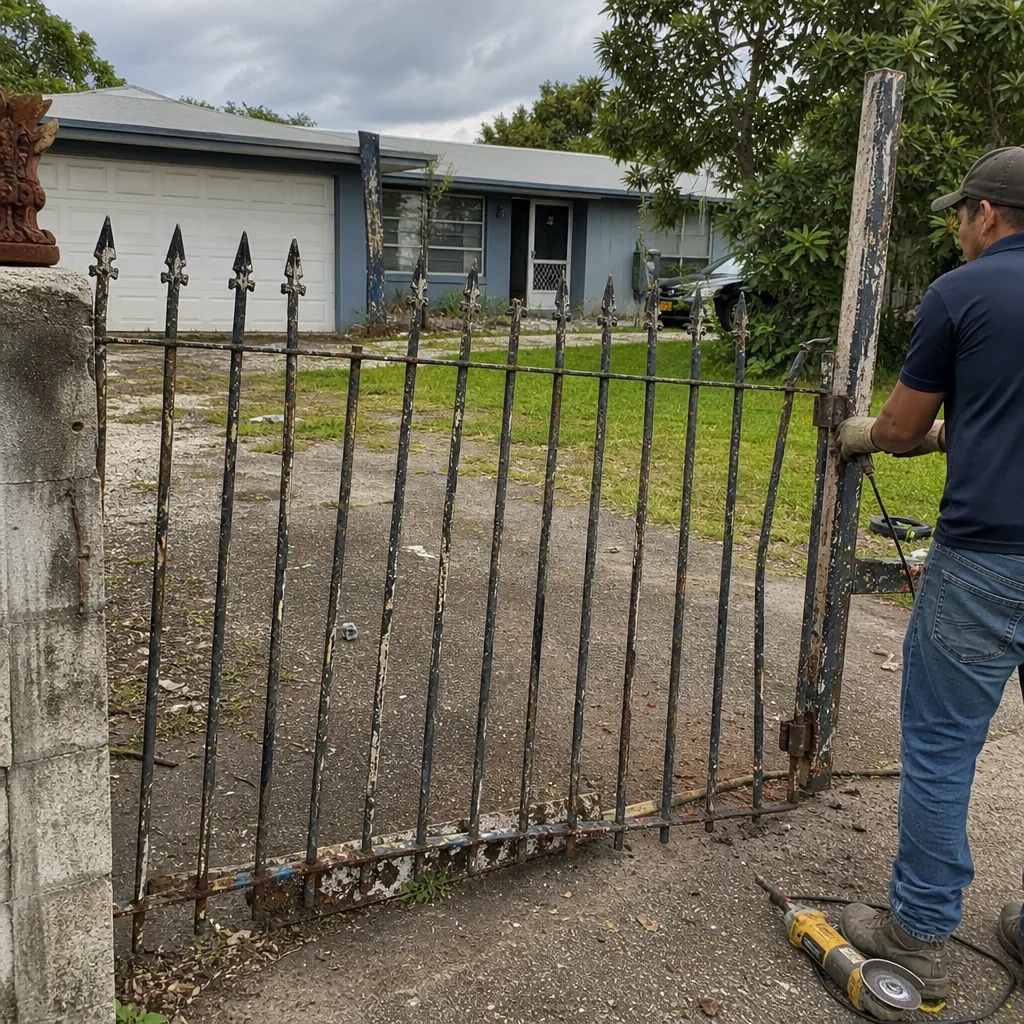 Before
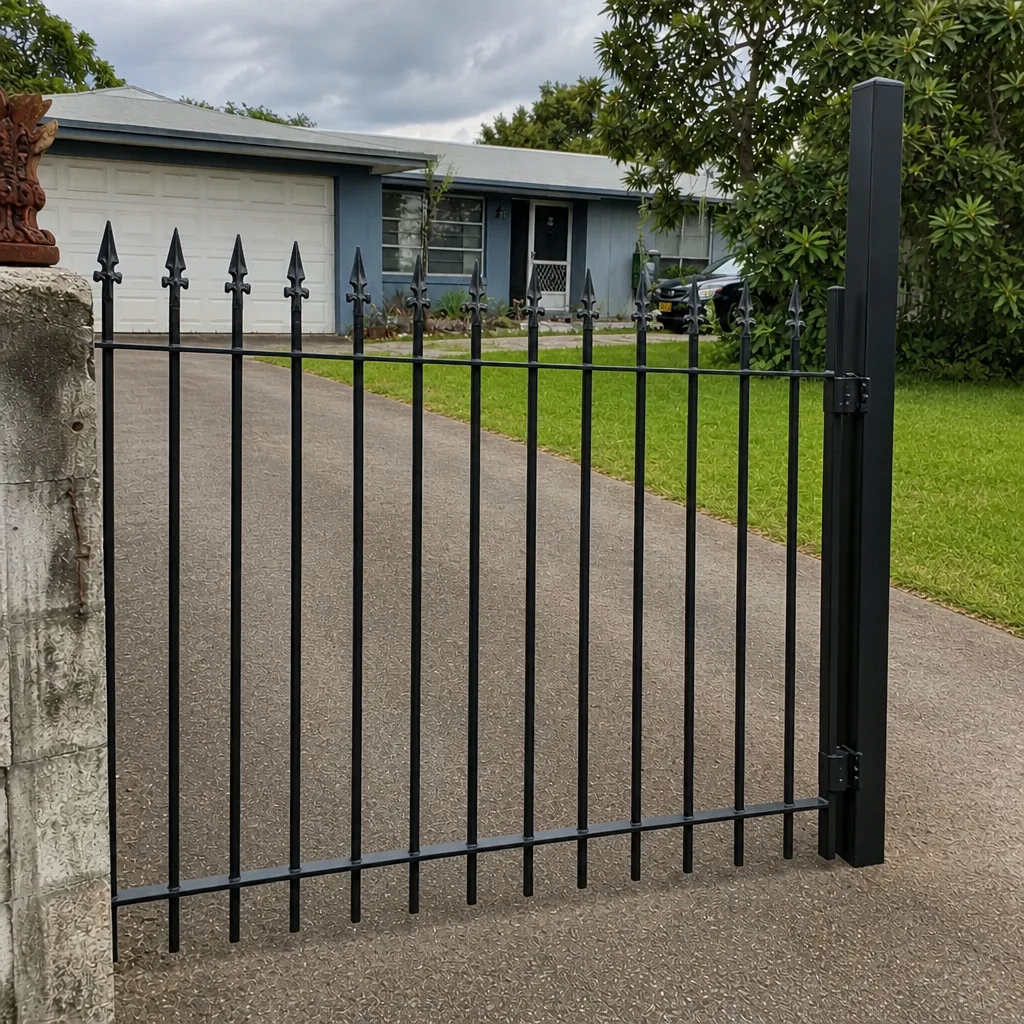 After
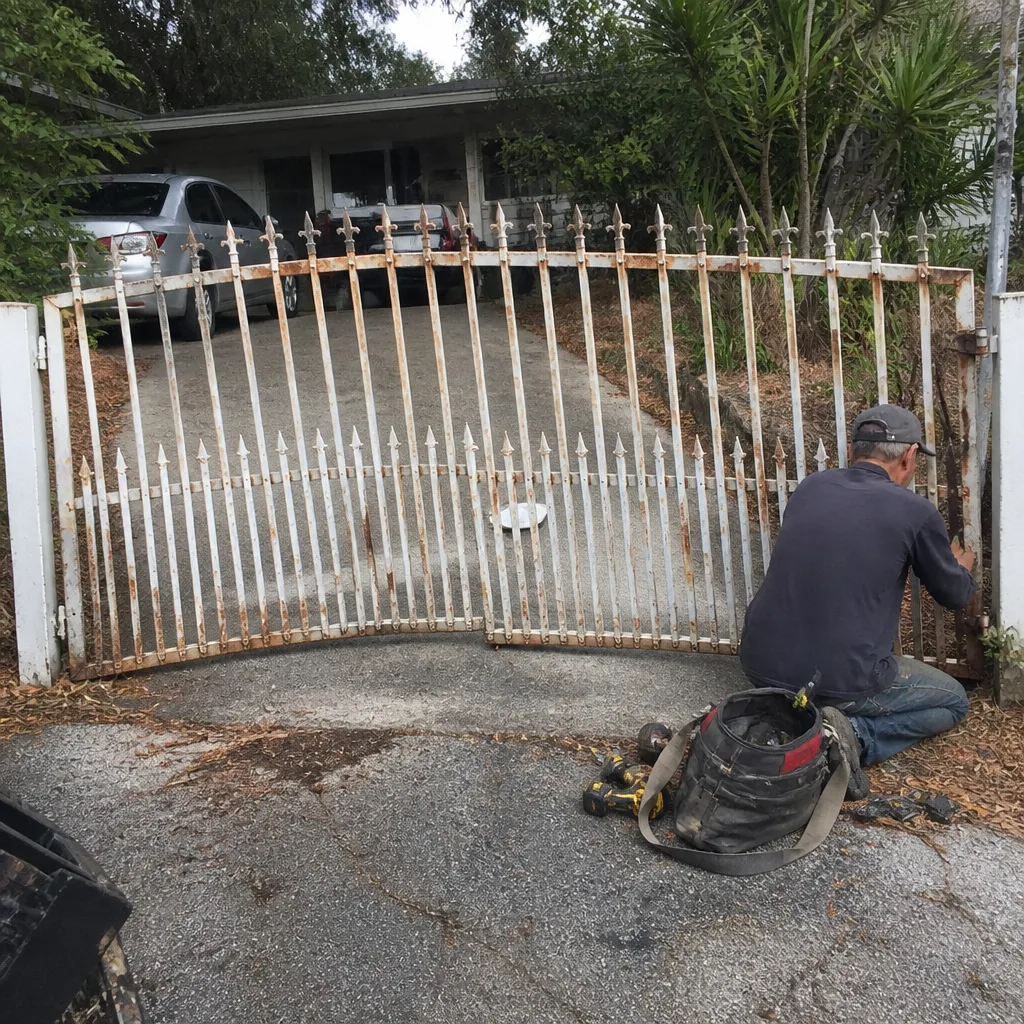 Before
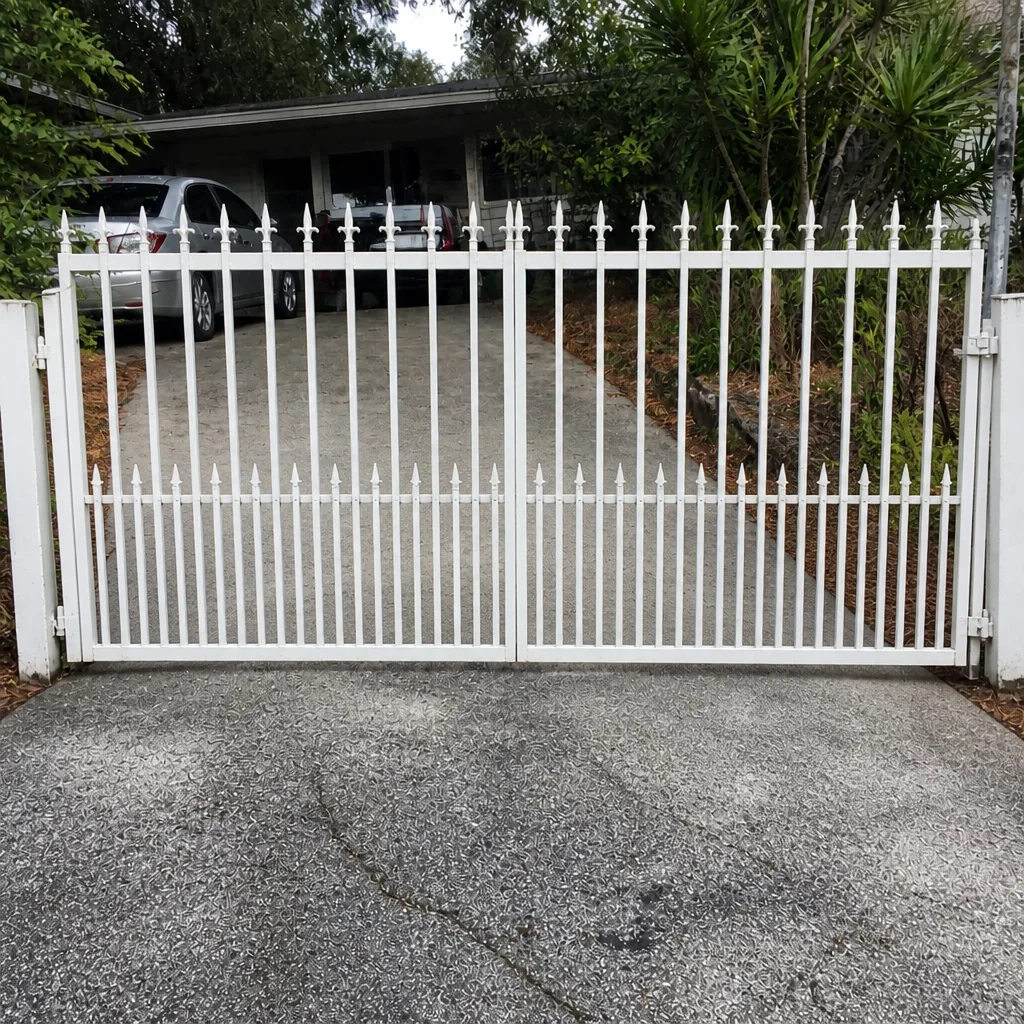 After
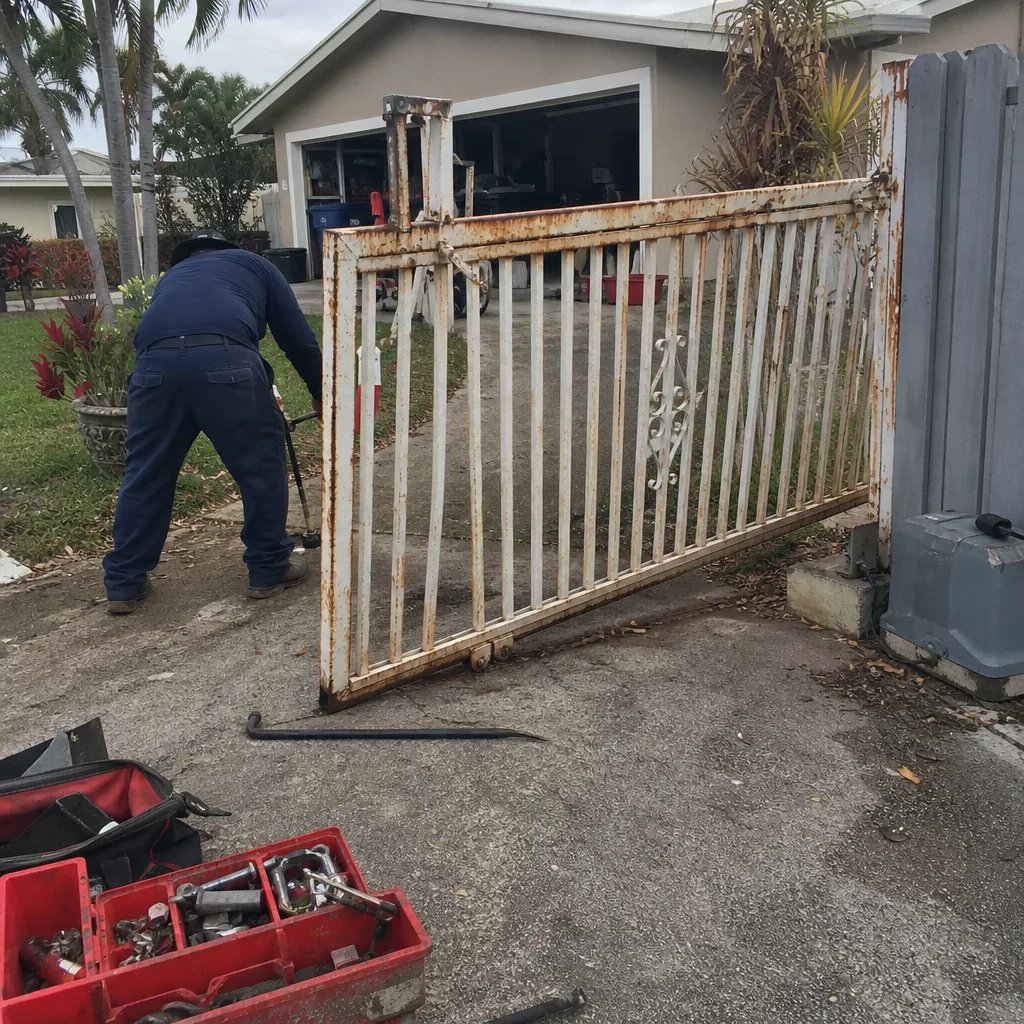 Before
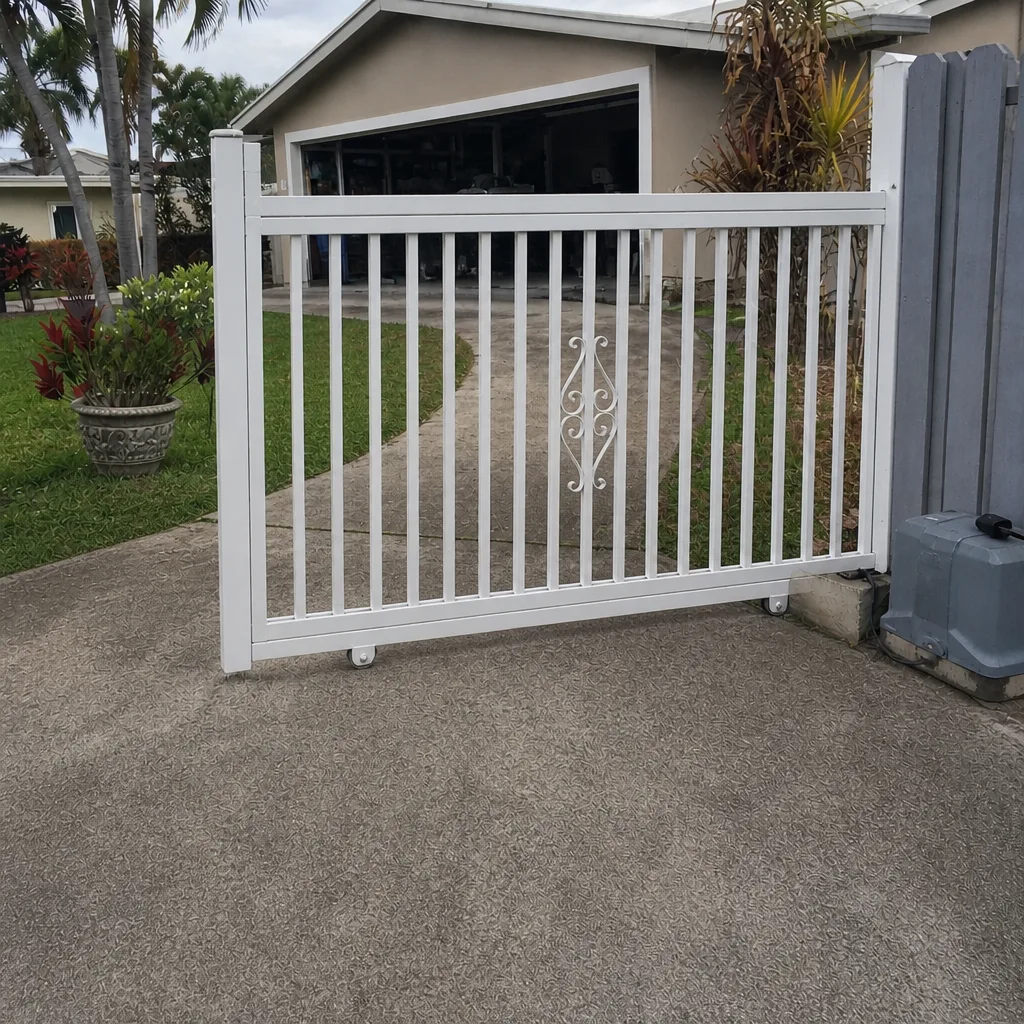 After
When to Call a Professional
Some jobs are a five-minute DIY tune-up. Others are a call. Bring in a dedicated gate technician when a panel hangs loose, when hardware is bent or a slide gate is off its track, when the operator won’t run or runs erratically, when the backup battery won’t hold through a cycle, or when the safety edges and photo eyes don’t test correctly. Anything involving the operator’s wiring and power, a heavy panel that could crush, or a gate that won’t latch safely should be handled by a trained professional rather than worked on yourself. Our technicians have up to 12 years of experience and work on both the gate and its automated system. Gate Repair Pompano Beach offers free estimates in Pompano Beach – call (888) 399-8022. We answer 24/7, with fast dispatch from 7am to 7pm, Sunday through Friday.
Frequently Asked Questions
Every three months for the core cycle – hinges, rollers, chain or rack, and the operator – with extra pre- and post-storm checks each season. Warm, humid conditions here wear gates faster than a drier climate would, so quarterly is the practical minimum rather than an annual pass. Call (888) 399-8022 for a free estimate if you’d rather have it done.
Because heat ages sealed lead-acid batteries quickly, and a once-a-year test can miss one that’s already failing. Running the gate on battery alone each quarter tells you whether it will actually hold during a power cut. If it’s sluggish or cuts out, replace it before the next storm.
The driven parts wear first: the exposed chain or rack and the roller and idler bearings that carry the panel. They take the most load and are the easiest to forget at lubrication time. Keeping them clean and lubricated on the quarterly cycle is what prevents premature wear.
You should be able to, but only if the manual release is working. Test it at every pre-season inspection – a seized release leaves you locked in or out when the power is down. If it won’t move cleanly, that’s a repair to handle before storm season.
Routine maintenance is the scheduled quarterly pass that prevents failures – lubrication, inspections, battery and safety tests. Emergency repair is when the gate won’t run, a panel is off its track, or the operator has failed. A steady maintenance schedule is what keeps you out of the emergency column.
Dates, what you did, the battery load-test result, specific observations, and any noises or behavior during cycles, plus the operator’s brand if you know it. Detailed notes let a technician pinpoint the motor, board, or hardware instead of guessing, which saves time and money.
The Bottom Line
A gate maintenance schedule that works in Pompano Beach isn’t the one printed in a national manual. It’s a quarterly core cycle timed to the June-through-October storm season, matched to your gate’s material, with all three lubrication points covered, the backup battery load-tested every quarter, and a simple log that speeds every future repair. Do the small quarterly pass and the pre- and post-storm checks, and you prevent the failures that strand property owners mid-season. Whether it’s the motor, the board, or the hardware, a dedicated gate specialist – familiar with the brand you already have across FAAC, BFT, Linear, Viking, and more – is what turns maintenance into fewer emergencies. Call (888) 399-8022. We answer 24/7. Fast dispatch from 7am to 7pm, Sunday through Friday.
Written by the team at Gate Repair Pompano Beach.