
Last updated November 15, 2026
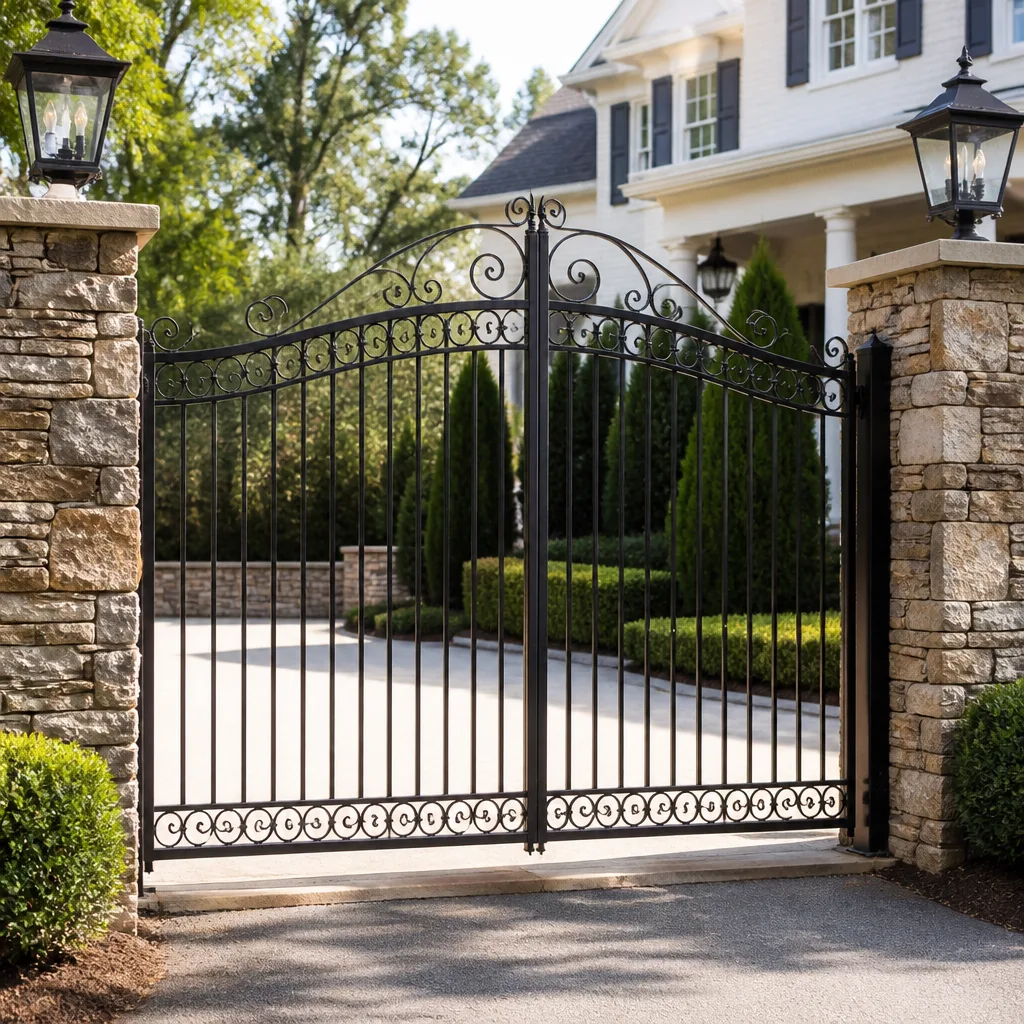 Wrought iron
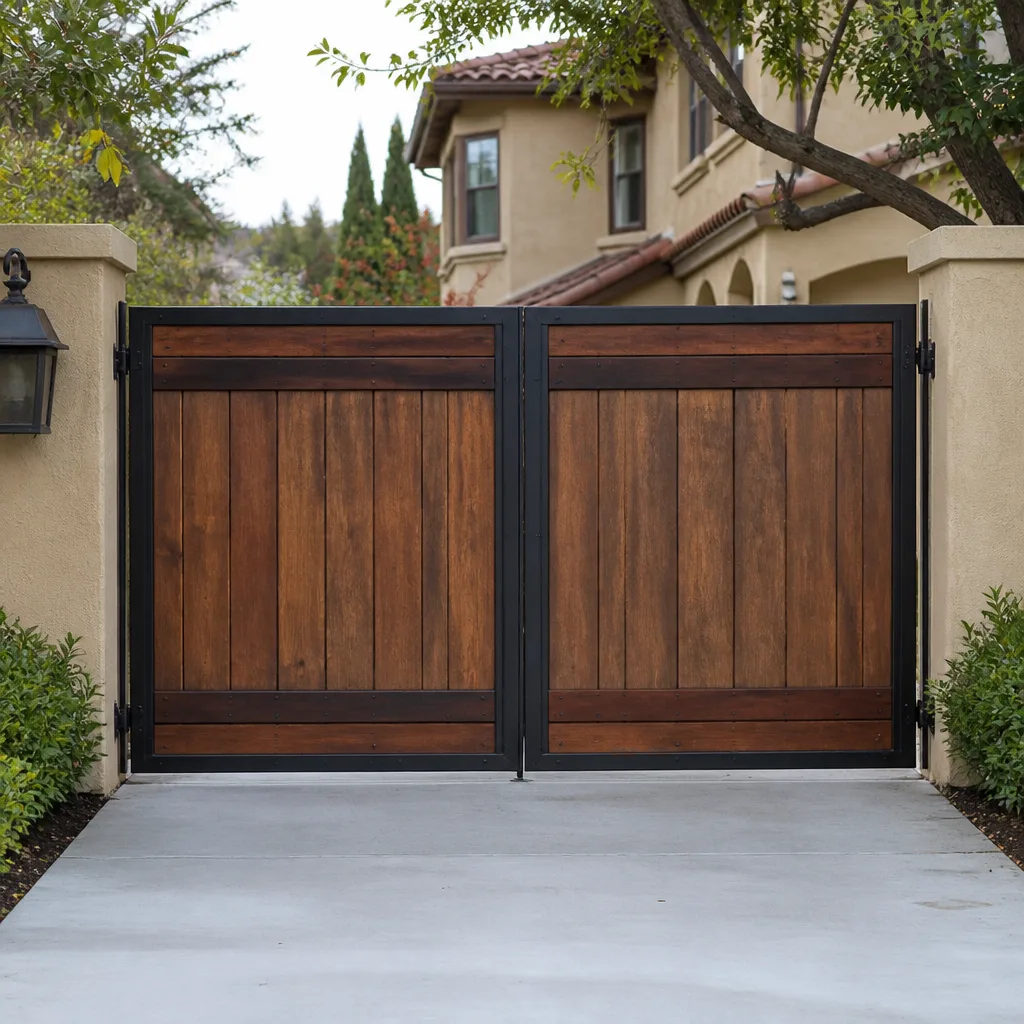 Wood & steel frame
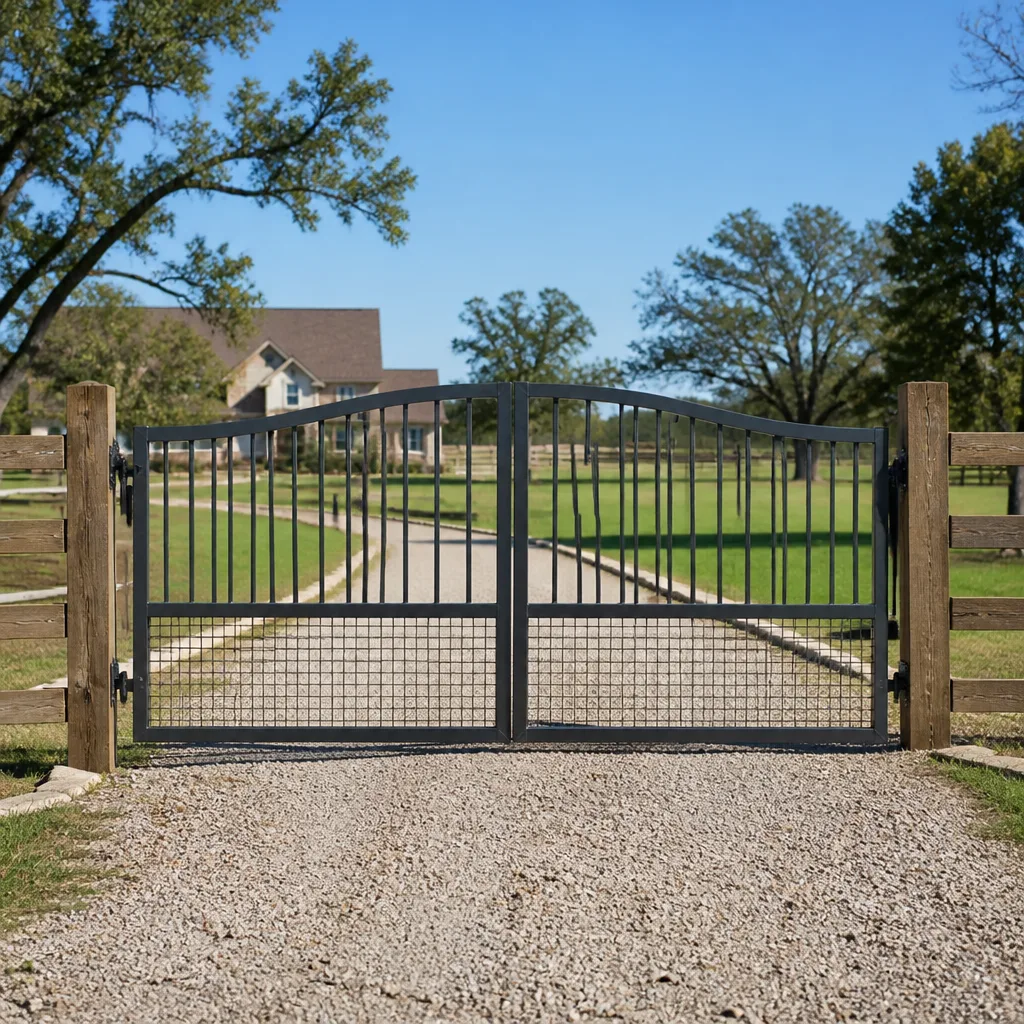 Farm & ranch
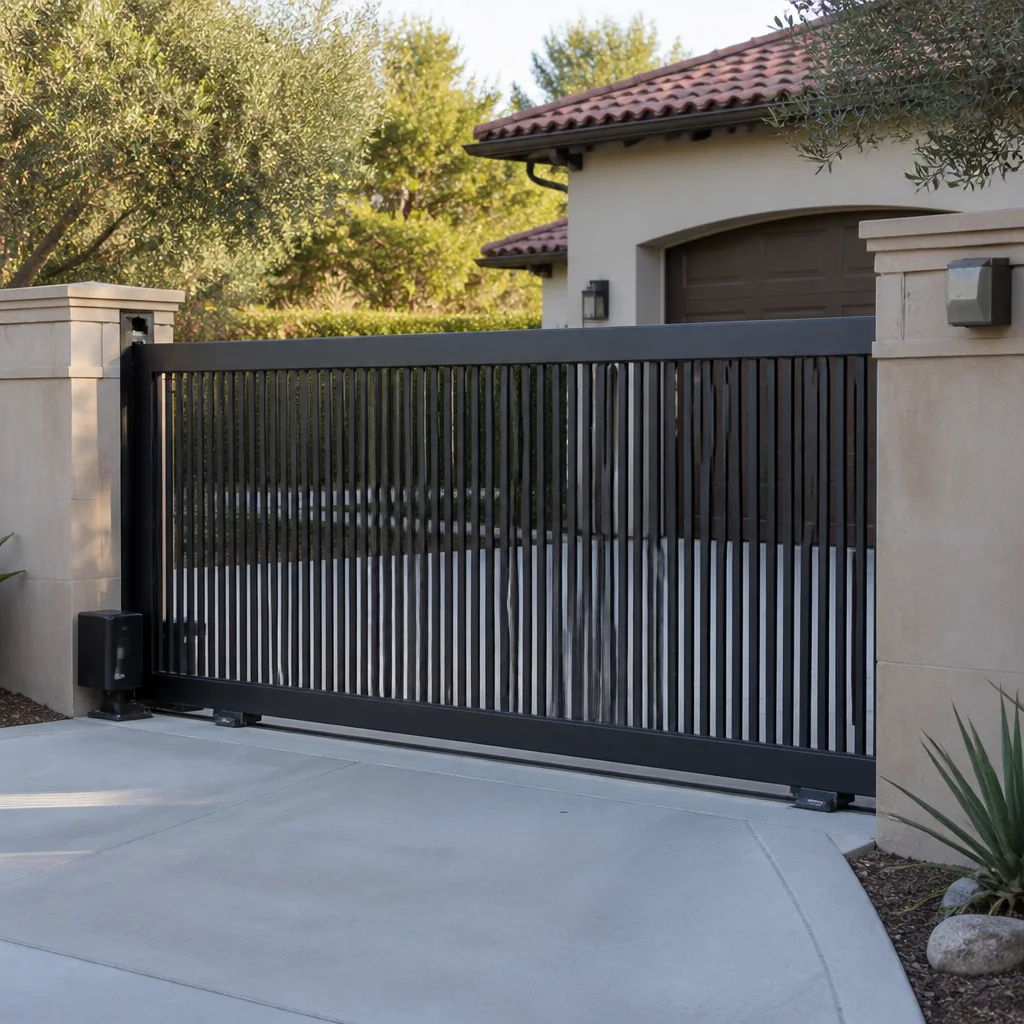 Sliding driveway gates
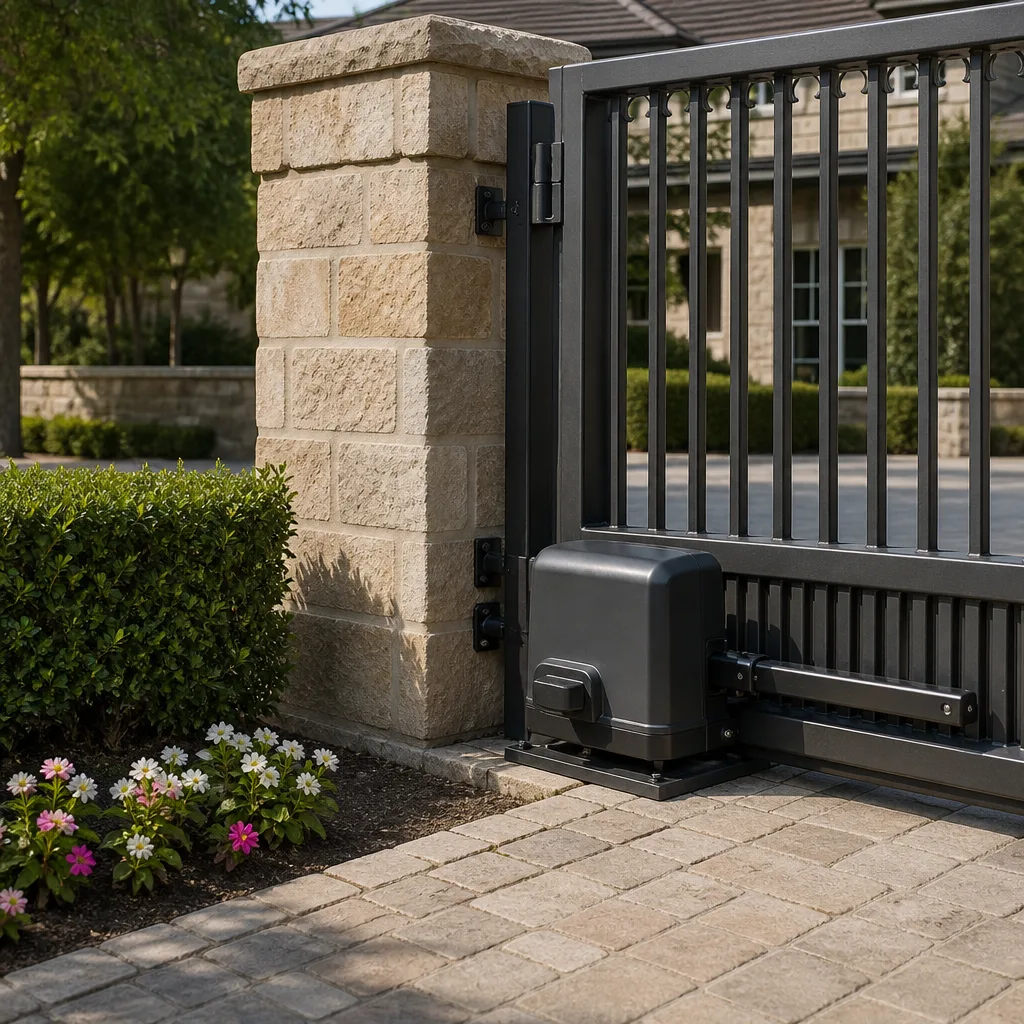 LiftMaster operators
Free on-site gate assessment - hinges, posts, and your LiftMaster or Nice gate operator checked before anything is quoted
The assessment is free and the quote is the invoice.
Get your free estimateGate Repair Warning Signs: A Pompano Beach Homeowner’s Reference Guide
A gate that hesitates for two seconds before it moves isn’t “a little slow.” That pause is usually a capacitor that’s lost a chunk of its charge capacity, and left alone it tends to strand a vehicle in your driveway sooner than you’d like. Most gate failures don’t arrive without warning – they announce themselves through specific mechanical and electrical signals days or weeks ahead of the breakdown. The trouble is that the same sound means different things on different gates. This guide matches symptoms to systems so you can describe your problem accurately and know what’s actually urgent. We’ll walk through the warning signs we see most often on properties around Pompano Beach.
Quick Answer
The most reliable gate repair warning signs are a delay before the gate moves, grinding or popping noises, a gate that reverses on its own, arms or tracks that have gone visibly crooked, and error codes on the control board. Mechanical signals point to hinges, tracks, chains and structure; electrical signals point to the motor, capacitor, control board or safety sensors. Matching the symptom to the right system is what tells you whether to monitor it or call a technician now. In Pompano Beach, the humid subtropical climate adds one more wrinkle: moisture-driven corrosion and swollen wood or settling posts show up here faster than in drier parts of the country.
Styles & brands we work with
- Wrought iron
- Wood & steel frame
- Farm & ranch
- Sliding driveway gates
- LiftMaster operators
Table of Contents
- Electrical vs. Mechanical: Which System Is Actually Failing?
- The Sounds That Tell You What’s Wearing Out
- What Gate Error Codes Really Mean
- How South Florida Humidity and Rain Show Up on Your Gate
- Safety Sensor Red Flags Most Homeowners Miss
- Urgent vs. Monitorable: A Warning Sign Priority List
- How to Describe Your Gate Problem Before You Call
Electrical vs. Mechanical: Which System Is Actually Failing?
Before you pick up the phone, it helps to know which half of your gate is complaining. A gate is a mechanical structure driven by an electrical system, and the symptoms split cleanly once you know what to look for. Getting this right means you describe the problem accurately, and a technician arrives already thinking about the right component instead of starting from zero.
Electrical warning signs usually involve timing, responsiveness or the control board:
- The gate pauses before moving, then runs normally once it starts.
- It stops partway and reverses without hitting anything.
- The remote works only when you’re close to the gate, or not at all.
- An error light blinks in a set pattern on the operator housing.
- The gate runs but the motor sounds strained, or it trips a breaker.
Mechanical warning signs are about motion, alignment and sound:
- The gate sags, drags, or scrapes the ground at one end.
- Hinges squeal or pop as the gate swings.
- A slide gate shudders, jumps the track, or rolls unevenly.
- You can wiggle the gate on its posts by hand.
- The chain or drive arm looks loose, worn, or out of line.
Many failures are both at once. A binding hinge forces the motor to work harder, which overheats the control board over time. Diagnosing only the electrical side means the mechanical cause keeps chewing through parts. That’s why we troubleshoot the whole system rather than defaulting to a replacement. Our technicians have up to 12 years of experience reading these combined failures, and the pattern is usually visible within the first few minutes on-site. If you’re already sure it’s the operator and not the structure, our electric gate repair team handles that side directly.
The Sounds That Tell You What’s Wearing Out
A gate makes noise as it works, and the type of noise is a diagnostic clue. The key is that the same sound can mean different things on a swing gate versus a slide gate, so match the sound to the mechanism you actually own.
Grinding on a sliding gate
Grinding on a slide gate usually means the rollers or the track, not the motor. Debris in the track, a flattened roller, or a rail that’s shifted out of alignment all produce a low grind. On a swing gate, a grind more often points to the operator’s gears or the drive arm. If the noise started suddenly, suspect an obstruction or a foreign object. If it built up gradually, suspect wear.
Popping or snapping at the hinges
This is hinge wear. A dry or worn hinge pops as the gate swings past a certain point. It’s monitorable for a short while, but a hinge that’s seizing puts strain on the operator every cycle. A quick inspection by a technician and a proper lubrication schedule usually resolves it before it becomes a motor problem.
Rattling or slapping chains
On chain-driven slide gates, a slack chain slaps against the housing or the rail. It’s one of the most common calls we get, and it’s a sign the chain has stretched or the tensioner has loosened. Left alone, a slack chain can jump the sprocket and stall the gate completely.
Humming without movement
A motor that hums but doesn’t move the gate is a classic electrical signal. It usually means a failed capacitor, a seized mechanism the motor can’t overcome, or a control board fault. Don’t keep cycling it – a motor that can’t turn while powered will overheat.
In our experience around Pompano Beach, homes near the Intracoastal and older neighborhoods with mature trees see the widest range of these sounds, because debris, moisture and settling are all in play. If you can hum the pitch and describe where it comes from, you’ve already helped the diagnosis.
What Gate Error Codes Really Mean
Error codes are the gate’s way of telling you exactly what failed, but the manuals often describe them in language so vague it’s useless. Here’s a plain-English translation of what the common codes on Pompano Beach systems typically indicate. Exact code numbers vary by model, so treat this as a map of the categories, not a substitute for your manual or a technician’s read of the board.
LiftMaster systems
LiftMaster operators use a blinking diagnostic LED on the control board. A certain number of blinks in a repeating pattern points to a specific fault category – obstruction, sensor fault, limit error, or a board-level issue. The manual will list the blink counts; the trick is to count the full cycle, because a single blink pattern and a double blink pattern mean very different things.
Mighty Mule systems
Mighty Mule operators commonly use audible beeps or light patterns. Repeated beeps more often point to an obstruction or a safety-sensor problem, while a single beep on power-up is usually normal. If the gate beeps every time it tries to close and then reverses, look at the sensors and the limit switches first.
Viking and Linear systems
Viking and Linear boards vary by generation, but the pattern is consistent: a fault code that points to the limit switch means the gate has lost track of its open or closed position; a fault that points to the motor means the board senses strain or no movement; a fault that points to the sensor means the safety loop or photo eye isn’t reporting. A generic “system fault” code almost always traces to one of those three areas. We’ve worked on all of these systems enough to know the board’s vague language for exactly this reason.
FAAC and BFT systems
FAAC and BFT openers, common on swing gates and property entry systems, tend to report limit, obstruction, and encoder faults through LED sequences. An encoder fault means the gate’s brain has lost the signal that tells it how far the gate has moved – often a magnetic sensor or wiring issue rather than a bad motor.
If you can note the code before you call, we can often tell you what’s likely wrong before we arrive. That’s the whole point of accurate diagnosis first. If your system is one we don’t see as often, our gate repair team still diagnoses by symptom, not by brand name.
How South Florida Humidity and Rain Show Up on Your Gate
Pompano Beach sits in a humid subtropical climate with warm, wet summers and heavy seasonal rain. That environment doesn’t create new gate problems, but it speeds up the usual ones. Corrosion, moisture intrusion and settling are the three big ones, and all three leave visual clues long before they stop your gate.
Corrosion on the components
The first place corrosion shows up is the fasteners and the control enclosure – the hinge pins, the mounting bolts, the terminal connections, and the seam of the operator box. What looks like a faint chalky bloom or white residue on a bolt, or a slightly rusted bracket, is your cue to have it looked at. Early intervention means cleaning and protecting connections and hardware; late-stage means replacing seized parts and tracking down intermittent electrical faults that never show up when you want them to. If you see rust streaks running down from a hinge or a bracket, don’t wait for the gate to seize.
Moisture in the control board
Humidity alone doesn’t usually kill a control board, but standing water, a failed gasket, or a housing with the wrong tilt lets moisture in. A board that’s showing intermittent faults, especially after a rainstorm, has moisture intrusion until proven otherwise. That’s a call-a-technician sign, not a wait-and-see sign.
Settling posts and swollen wood
In the wet season, soil movement and moisture can settle a gate post, and wooden gates can swell. Both throw the gate out of square: the gate starts to drag, or it no longer aligns with the strike or the latch. A gate that used to close cleanly and now catches at the corner is a structural signal. Posts go to proper footing depth at installation, and re-leveling a post is a job for a technician who knows the hardware.
Beyond the humidity, storm winds and fallen limbs are the seasonal disruptors here. After a heavy weather week, walk your gate line and look for anything that changed: a leaning post, a misaligned arm, a chain that’s off the sprocket.
Safety Sensor Red Flags Most Homeowners Miss
Safety sensors are the component most often overlooked because they can fail in a way that makes the gate more dangerous, not less – and the gate still opens and closes, so nothing looks wrong. The sensors are the photo eye pair (a beam across the opening) and the loop sensor (buried in the driveway that detects a vehicle).
Here’s the red flag that matters most: a failing safety system often causes the gate to close despite an obstruction. When the photo eye is misaligned or its lens is dirty or fogged, the beam may never complete, and some systems interpret an incomplete beam as “clear” or “no signal” and keep moving. The gate still works, which is why nobody notices. The risk is real – a gate that doesn’t reliably detect a person or a car can trap or crush.
Specific red flags to watch for:
- The gate closes even when something is clearly in its path.
- The photo eye lens looks cloudy, cracked, or has debris or spider webs on it.
- The gate reverses randomly, then works fine, then repeats.
- The gate closes only when you hold the button (a “constant pressure” mode may mean the sensor has been bypassed or failed).
- You hear the gate grind to a stop and re-open without any visible obstruction.
Don’t test a failing safety system by standing in the gate’s path. Test with a box or a wheeled object, watch for one or two cycles, and then stop cycling it. The safety edges and sensors are a trained technician’s job. Wiring and power on an automated gate carry real risk, and a heavy gate panel can crush – this is one area where the correct move is always to have someone qualified look at it. If any of these signs are present, treat it as urgent and get a specialist out promptly.
Urgent vs. Monitorable: A Warning Sign Priority List
Not every warning sign is a “call now” sign. Some are “call soon,” and some are “keep an eye on it and mention it at your next service.” Here’s how we’d rank them.
Call immediately
- The gate closes on or ignores an obstruction.
- The motor hums without moving the gate (stop cycling it).
- Burning smell, sparking, or a tripped breaker at the operator.
- A gate that has come off the track or is hanging, or a panel that’s loose on its hinges.
- Any exposed or damaged power wiring at the operator or the opening.
Schedule a visit soon
- A two-to-three second delay before the gate starts moving.
- New grinding, popping, or rattling that wasn’t there before.
- Intermittent error codes or behaviors, especially after rain.
- A gate that no longer sits square or latches cleanly.
- Visible corrosion or rust streaks on fasteners and brackets.
Monitor and note
- One hinge squealing now and then.
- A slightly slow start that’s been the same for a while.
- A gate that occasionally needs a second press of the remote.
The rule of thumb: anything that affects motion, alignment or the motor is schedule-soon, and anything that affects safety, wiring or a hanging structure is call-now. The two-second delay is the one we’d flag hardest, because it usually escalates. Call (888) 399-8022 for an exact quote if you’re wondering which bucket your symptom falls in. We answer 24/7, with fast dispatch from 7am to 7pm, Sunday through Friday. Estimates are free, and the price is quoted and agreed before any work starts.
How to Describe Your Gate Problem Before You Call
An accurate description on the phone turns into an accurate diagnosis on-site. It also means the technician arrives with the right parts and the right expectations. Here’s a quick way to gather what matters:
- Note what the gate does: does it hesitate, reverse, stop, or fail to move at all?
- Note when it happens: on opening, on closing, both, or only after rain or a storm.
- Note any sounds: grind, pop, rattle, hum, beep. Where does the sound come from?
- Note any visible issue: sagging, dragging, loose hinges, rust, debris in the track, a chain off the sprocket.
- Note any error codes or blinking lights on the operator, and the count in the pattern.
- Note the gate type: single swing, double swing, slide, residential or commercial.
- Note the brand if you can see it: LiftMaster, FAAC, BFT, Linear, Viking, Ghost Controls, DoorKing, Elite or Mighty Mule.
That last one matters more than most homeowners think. A system that’s not on the list can still be diagnosed by symptom, but knowing the brand and model helps a technician come prepared. If you’re not sure, a photo of the operator housing and the control board tells us a lot. If you want a baseline read on the overall health of a gate, our team at Gate Repair Pompano Beach can walk through it with you.
Common Mistakes to Avoid
- Cycling a gate that hums without moving. A motor that can’t turn while powered will overheat and can burn out the windings. Stop, then call.
- Spraying penetrating oil on everything. A little lubricant in the right spots helps; drowning the control board, the limit switches, or the photo eyes in oil or grease can attract debris and cause new faults. Lubricate hinges and moving metal, not electronics.
- Assuming a slow gate is just old. Most delays trace to a failing capacitor or a straining mechanism, not age. A technician can usually tell the difference in minutes without a replacement.
- Ignoring a safety-sensor fault “because it still opens.” A gate that still opens and closes is not the same as a safe gate. This is the mistake we’d most like to stop seeing.
- Letting storm debris sit in the track or on the gate line. In a wet South Florida season, debris holds moisture against rollers and hinges and accelerates wear. A quick clear-out after storms is cheap insurance.
- Replacing parts without diagnosing first. Swapping a motor because the gate is slow can leave the actual cause – a binding hinge or a bad capacitor – in place. Accurate diagnosis first saves money.
- Not knowing what your gate is made of or who made it. When you call, knowing the brand and gate type speeds up the whole process, whether you’re in a Pompano Beach neighborhood or a commercial property elsewhere in the area.
See the difference
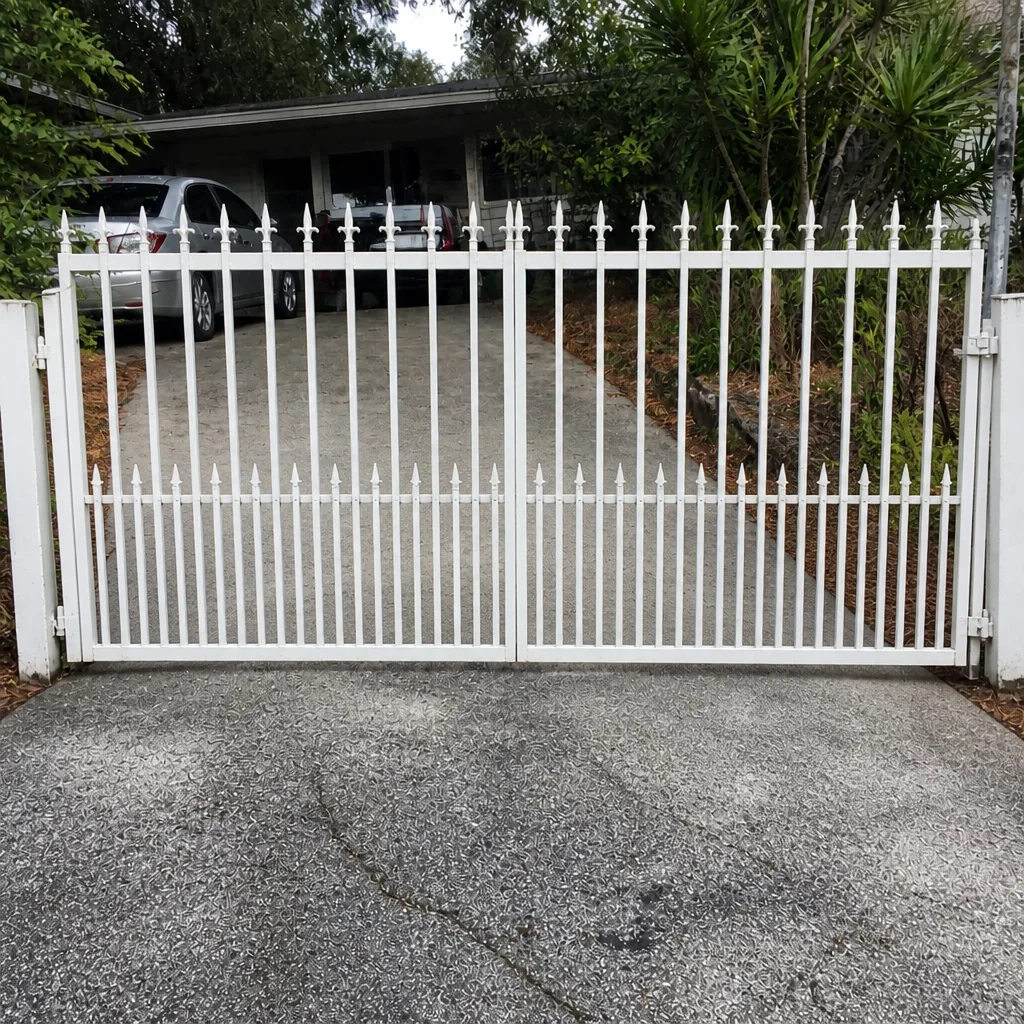
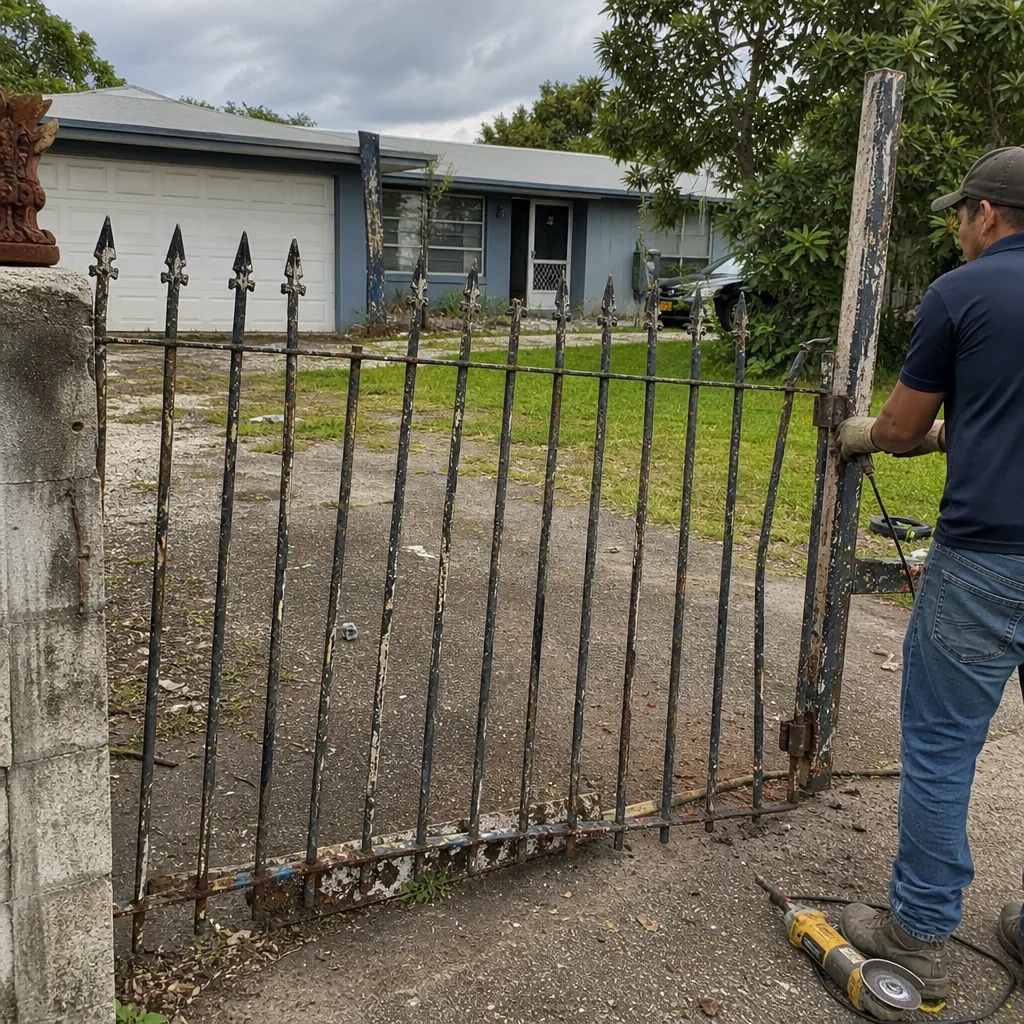 Before
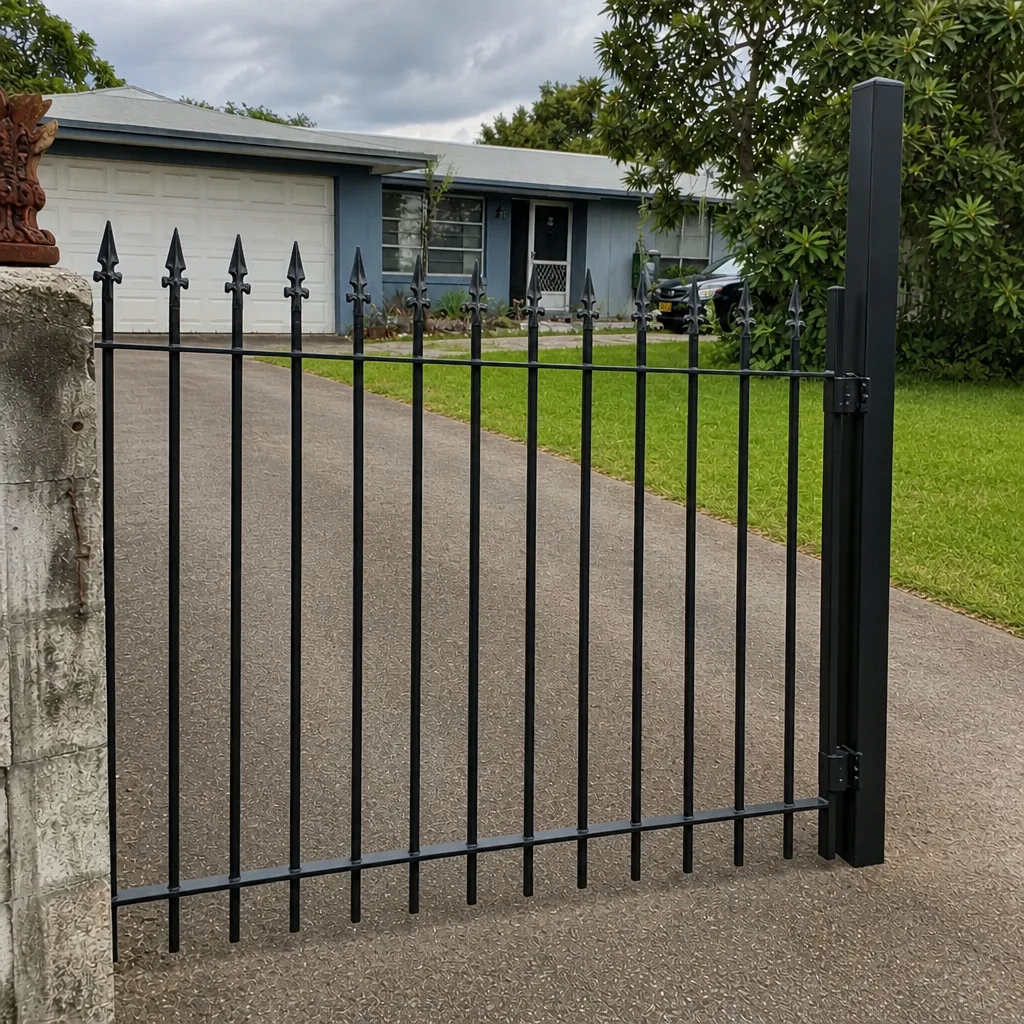 After
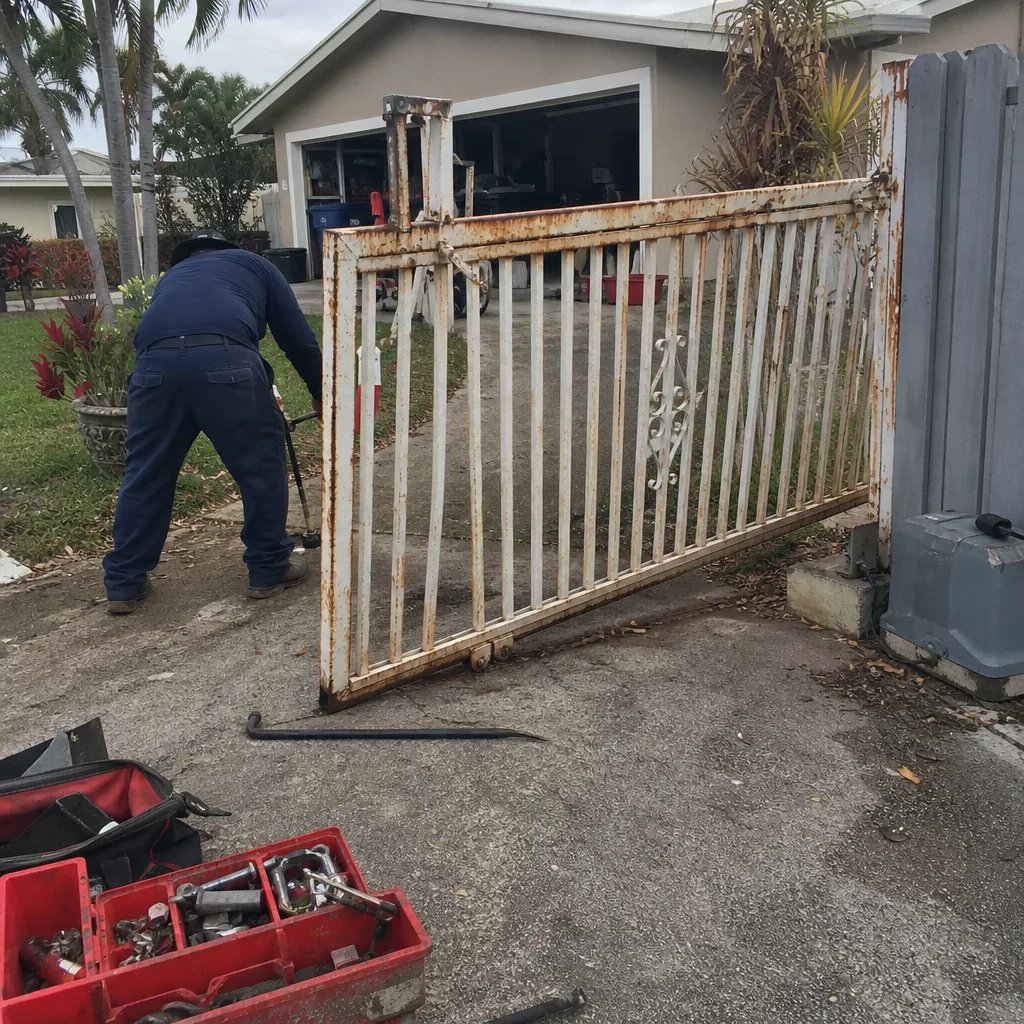
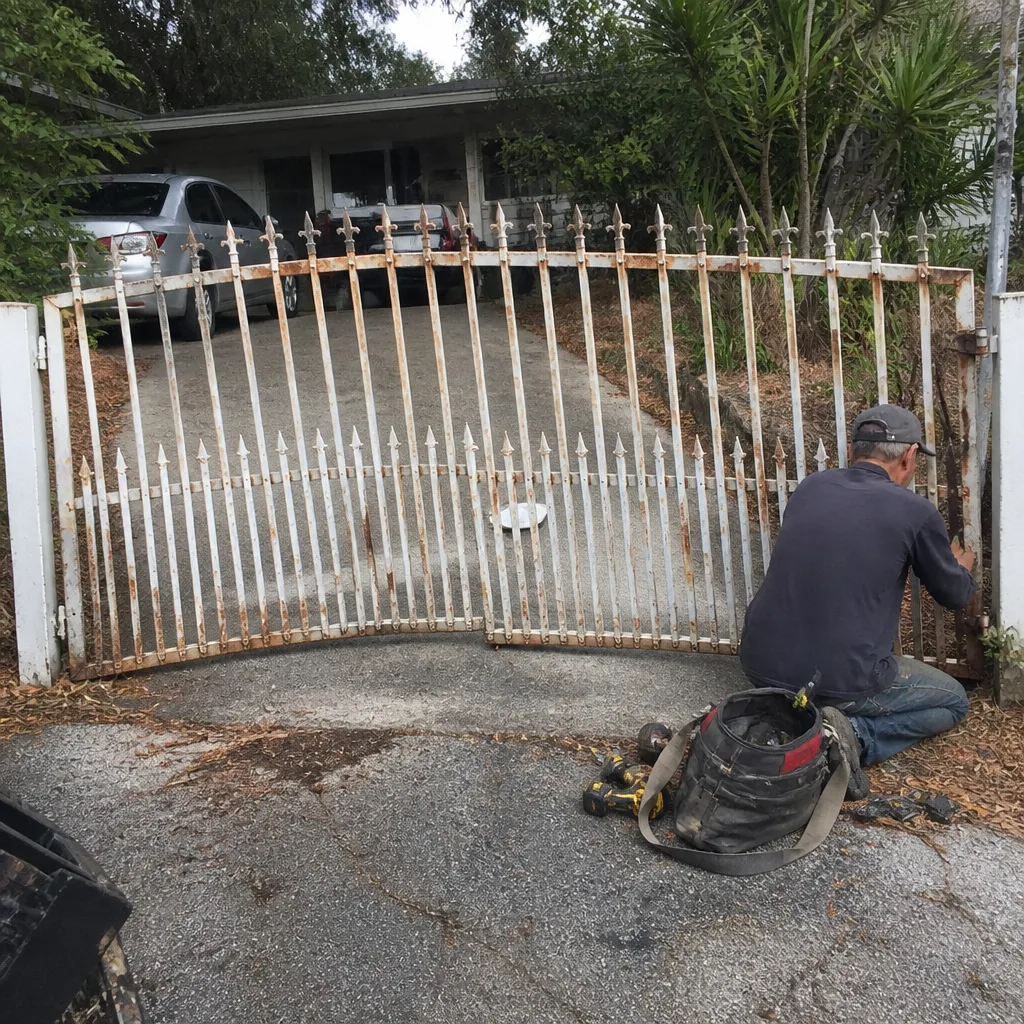 Before
 After
 Before
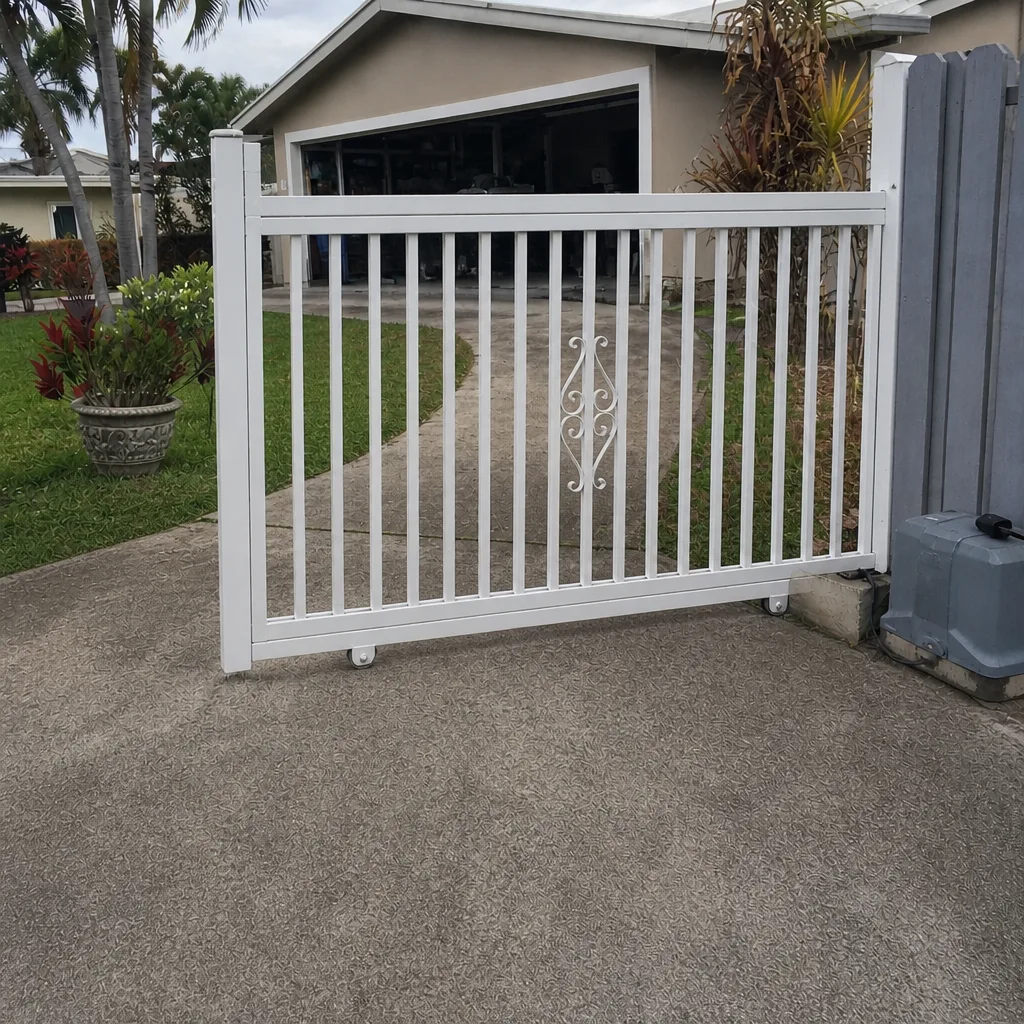 After
When to Call a Professional
Call a professional if your gate is affected by motion, alignment, the motor or the safety system. If the gate reverses on its own, if it closes despite an obstruction, if you see sway or wiggle in the posts, if you hear grinding or popping that wasn’t there before, or if the operator shows an error code you can’t explain, that’s our cue to look at it. Also call if the operator’s wiring or power is exposed or damaged, or if the gate has come off its track or is hanging. We don’t recommend homeowners attempt repairs on the operator’s wiring or on the structural panels of a heavy automated gate – the risk of injury or a serious electrical fault is real. Gate Repair Pompano Beach offers free estimates in Pompano Beach – call (888) 399-8022. We answer 24/7, with fast dispatch from 7am to 7pm, Sunday through Friday.
Frequently Asked Questions
The earliest reliable signs are a two-to-three second delay before the gate starts moving, a new sound (grind, pop, rattle or hum), and intermittent error codes or momentary reversals. Any of these is your early window to have the gate checked before a small repair becomes a larger one. Call (888) 399-8022 for an exact quote – estimates are free.
Yes, same-day repair is often possible when a technician is dispatched from our Pompano Beach team, depending on the parts needed for your specific system. We answer 24/7, and dispatch runs from 7am to 7pm, Sunday through Friday. For the fastest result, describe the symptom, the gate type and any error code when you call.
A blinking pattern on the control board is a fault code, not a general status. The number and pattern of blinks maps to a category – obstruction, safety-sensor fault, limit error, or motor and board issue. Note the full repeating pattern before you call and a technician can often tell you what’s likely wrong before arriving.
Gate repair is priced per job by a written estimate after a technician sees the gate, so the final number depends on the system, the parts and the access. The estimate itself is free. Because the price is quoted and agreed before any work starts, you know the cost before we begin. Call (888) 399-8022 for an exact quote – estimates are free.
A dedicated gate technician is the safer and usually cheaper choice. Gates – swing, slide, and automated electric – have specific mechanics, safety systems and control boards that a generalist rarely works on. Our team works on the brand you already have, from LiftMaster, FAAC, BFT, Linear, Viking, Ghost Controls, DoorKing, Elite and Mighty Mule systems, and we diagnose the actual problem rather than swapping parts to see what works.
No. A gate with a failing photo eye or loop sensor is less safe than it looks because it still opens and closes. If your gate moves when something is in its path, or if the sensor lens is damaged or dirty, treat it as urgent and get a technician out. Don’t test it by standing in the gate’s path.
The Bottom Line
Every gate failure has a trail of warning signs, and recognizing them early is what keeps a small repair small. Match the symptom to the system: timing, error codes and humming are electrical; grinding, sagging, rattling and popping are mechanical; and visible corrosion and a gate that’s gone out of square are the South Florida humidity at work. If the gate closes on an obstruction or the operator wiring is compromised, that’s an immediate call. If the gate hesitates or a new sound has appeared, schedule a visit before it becomes a breakdown. The earlier you describe the problem, the sooner you’re back to a gate that works. If you’re in Pompano Beach and unsure which bucket your symptom falls into, our Pompano Beach team can help.
Call (888) 399-8022 for a free estimate. We answer 24/7, with fast dispatch from 7am to 7pm, Sunday through Friday. The price is quoted and agreed before any work starts.
Written by the team at Gate Repair Pompano Beach.